
If you’re researching how to become a nurse, you’re probably overwhelmed by conflicting advice about degrees, licensing, timelines, and what nursing school is really like. The truth is—there’s more than one path to becoming a registered nurse, and choosing the wrong one can cost you years and tens of thousands of dollars.
This comprehensive, ready guide answers the top 10 questions future nursing students must understand before applying. You’ll learn:
- Exactly how to become a nurse step-by-step
- Whether you should choose ADN or BSN
- How long it really takes depending on your starting point
- Prerequisites, GPA expectations, and disqualifying factors
- Costs, hidden expenses, and realistic funding strategies
- Whether you can become a nurse online or while working
- State licensing differences and NCLEX essentials
- How to choose the right program, not just any program
By the end, you’ll walk away with a personalized action plan—not just information.
✅ At a Glance: Steps to Become a Nurse
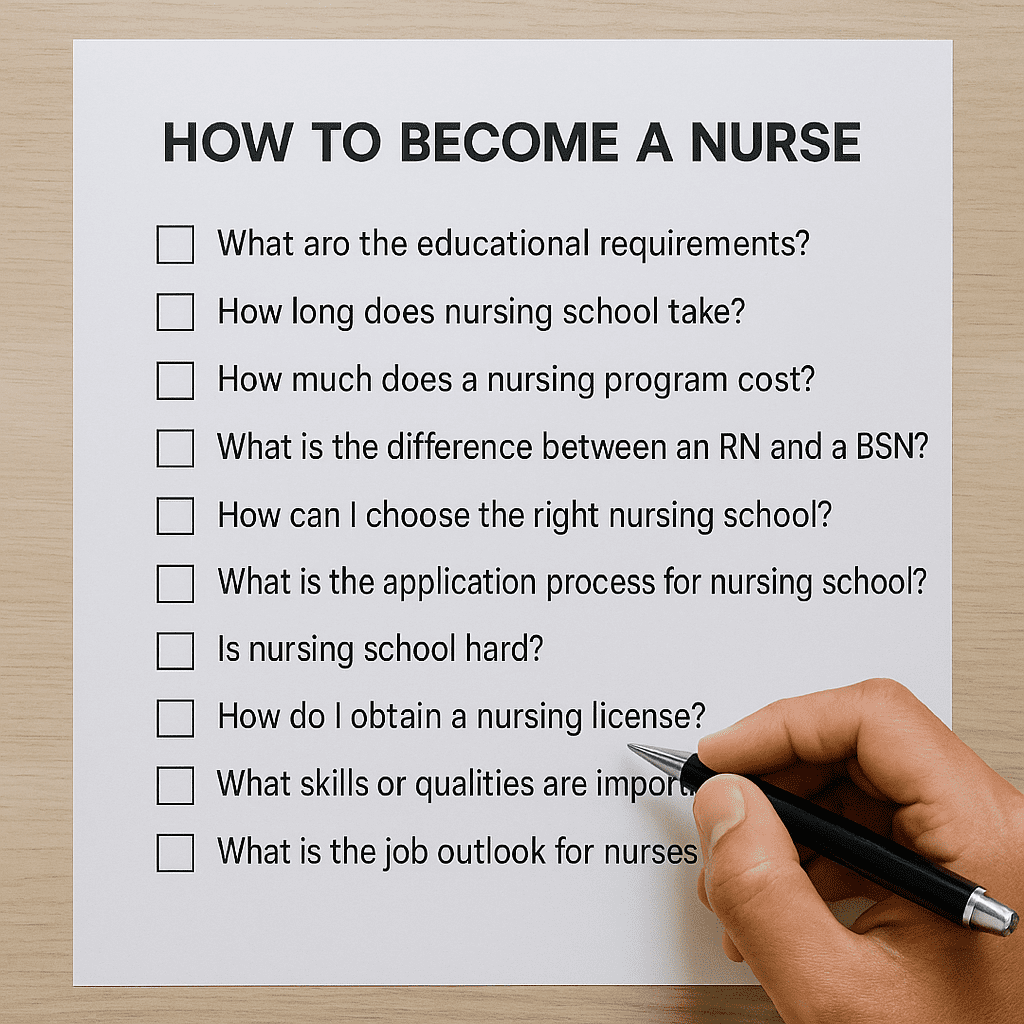
Here are the steps most people follow to become a Registered Nurse (RN):
- Earn a high school diploma or GED
- Complete required nursing prerequisites
- Apply to and enroll in an accredited ADN or BSN program
- Complete clinical and classroom training
- Graduate with your nursing degree
- Pass the NCLEX-RN licensing exam
- Obtain state RN licensure
- Get hired as a new graduate nurse
- (Optional) Advance into RN-to-BSN, MSN, DNP, or APRN roles
Use the AllNurseSchools program finder to compare accredited ADN and BSN programs by state, tuition, and format.
✅ 1. What does a nurse actually do day to day?
Most people picture nurses taking vitals or giving medications—but the real scope is much broader, more complex, and varies by setting.
Core responsibilities of registered nurses
RNs typically:
- Perform head-to-toe patient assessments
- Administer medications, IV therapies, and treatments
- Track changes in patient conditions and escalate concerns
- Coordinate care with doctors, therapists, and specialists
- Educate patients and families on discharge instructions
- Document all care in electronic health records
- Support patients emotionally through difficult situations
What surprises new nurses most
New graduates often report:
- The amount of critical thinking, not just task-doing
- The emotional weight of end-of-life care
- Managing multiple high-acuity patients at once
- The importance of communication and time management
Work environments make a huge difference
Your daily routine depends on where you work:
Hospitals
- Fast-paced, shift-based, weekends/holidays
- Higher acuity and rapid decision-making
- Often preferred for new graduate training
Outpatient clinics
- More predictable schedules
- Education-focused
- Chronic and preventive care
Long-term care
- Stable patient population
- Medication-dense shifts
- Often entry-friendly for new grads
Home health
- Independent work setting
- Travel between patients
- Strong assessment skills required
Public health & school nursing
- Prevention and community support
- Monday-Friday schedules
- Ideal for nurses who don’t want shift work
If you’re unsure whether nursing is the right fit, consider exploring CNA training or volunteering before applying.
✅ 2. What are the main paths to become a nurse?
When people search how to become a nurse, they usually mean becoming an RN, but there are multiple routes—each with different training, scope, and salary potential.

Entry-level nursing roles
| Role | Training length | License | Scope of practice |
|---|---|---|---|
| CNA | 4–12 weeks | Certification | Basic patient care tasks |
| LPN/LVN | 12–18 months | Practical nurse license | Medication administration in limited settings |
| RN | 2–4 years | RN license | Full nursing scope under state law |
| APRN | 6–10+ years | Advanced license | Independent/advanced practice (NP, CRNA, CNM) |
✅ Two primary education paths to becoming an RN
ADN (Associate Degree in Nursing)
- Typically 2–3 years at community colleges
- Prepares graduates for the NCLEX-RN
- Many students begin by exploring ADN programs to enter the workforce sooner
BSN (Bachelor of Science in Nursing)
- Typically 4 years at universities or colleges
- Includes leadership, community health, and research courses
- Increasingly preferred for hospital hiring—especially Magnet facilities
- Compare accredited BSN programs to review available options
✅ Bridge and accelerated pathways
Ideal if you’re not starting from scratch:
- LPN-to-RN bridges
- RN-to-BSN programs for working nurses
- Accelerated BSN programs for students with a non-nursing bachelor’s degree
- Direct-entry MSN (rare, but an option at select schools)
Your starting point determines the smartest path—not all require four years.
✅ 3. Do I need a BSN, or is an ADN enough?
Short answer: Both lead to RN licensure, but they’re not equal in long-term outcomes.
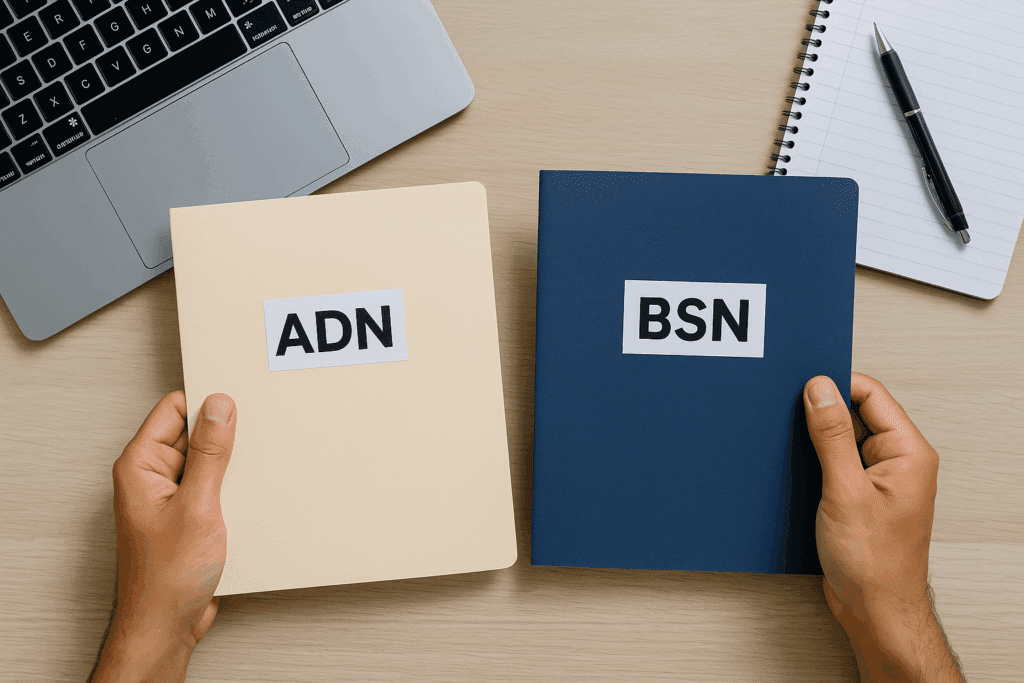
ADN vs BSN comparison (expanded)
| Factor | ADN | BSN |
|---|---|---|
| Length | 2–3 years | 4 years |
| Cost | Lower overall | Higher total investment |
| Hiring | Accepted widely, but limited in some hospitals | Preferred for hospital hiring and leadership |
| Advancement | Requires later bridge | Required for MSN/APRN |
| Competitiveness | Can be entry-friendly | Increasingly expected in major health systems |
| Flexibility | Faster workforce entry | Best long-term mobility |
Market reality
- Some states and hospitals require BSN-in-10 (e.g., New York’s legislation)
- Magnet hospitals prioritize BSN hiring
- Research links BSN-prepared nurses with improved patient outcomes
Most common modern pathway
ADN → work as an RN → complete RN-to-BSN programs online in 12–18 months.
This strategy offers both speed and long-term flexibility.
Timelines vary widely, and the fastest option isn’t always the best fit. If you’re unsure which path matches your goals, try our nursing career quiz before choosing a program.
✅ 4. How long does it take to become a nurse?
Short answer: It usually takes 2–4+ years, but timelines vary based on education level and prior credits.
✅ Scenario-based timelines
Scenario 1: Starting from zero
- Prerequisites: 6–24 months
- ADN program: 2–3 years
- Total: 2.5–4 years
Scenario 2: Already completed general education
- Prereqs shorter
- ADN or BSN length reduced
- Total: 2–3.5 years
Scenario 3: Second-degree student
- Accelerated BSN programs: 12–18 months
- Intensive—no full-time work recommended
Scenario 4: Working LPN
- LPN-to-RN bridge: 12–24 months
- Many programs offer part-time formats
✅ Post-graduation timeline
- NCLEX prep + scheduling: 4–12 weeks
- State licensure: varies (2–12+ weeks)
- Job search: depends on market—urban areas more competitive
Interested in the fastest route? Explore fast-track BSN programs if you already hold a bachelor’s degree.
✅ 5. What prerequisites and GPA do nursing programs require?
Requirements vary—but there are consistent expectations across most schools.
✅ Common prerequisite courses
- Anatomy & Physiology I and II
- Microbiology
- Chemistry or Biology
- Human Growth & Development
- Statistics
- Nutrition
- English composition
- Psychology or sociology
✅ GPA expectations
- Minimum cumulative: 2.75–3.0
- Competitive programs: 3.3–3.8 in science coursework
- Some schools weigh prerequisite GPA more heavily than overall GPA
✅ Entrance exams
Most programs require one of the following:
- TEAS (Test of Essential Academic Skills)
- Common cutoff: 65–75%+
- Strong programs: 78–85%+
- HESI A2
- Schools may set section-based minimums
✅ Other admission requirements
- Background check and drug screening
- Immunization records (MMR, Hep B, TB, etc.)
- CPR certification (AHA BLS)
- Letters of recommendation
- Personal statement or interview
✅ Possible disqualifiers
These vary by state but may include:
- Certain criminal convictions
- Positive drug screenings
- Incomplete immunizations
- Academic dishonesty records
- Failed prerequisite attempts (school-dependent)
Always verify through nursing school NCLEX requirements by state and your state board.
✅ 6. How much does nursing school cost—and how do I pay for it?
Nursing school costs vary widely based on program type and institution.
✅ Average tuition ranges
- ADN programs (community college): $6,000–$20,000
- BSN programs (public university): $40,000–$80,000
- BSN programs (private schools): $80,000–$120,000+
- Accelerated BSN programs: $50,000–$90,000 (intensive, fast-track)
✅ Hidden costs students often overlook
- Scrubs and clinical uniforms
- Stethoscope and medical supplies
- Background checks and drug testing
- Vaccination updates and titers
- Textbooks and online platforms
- Transportation to clinical sites
- NCLEX registration fee
- NCLEX prep courses
✅ Financial aid and funding options
- Federal student aid via FAFSA
- School-based scholarships
- State nursing scholarships
- Employer tuition reimbursement programs
- Military and GI Bill benefits
- Loan repayment programs for nurses in high-need areas
To compare tuition and fees in your area, review nursing program costs through the program finder.
✅ 7. Can I become a nurse online or while working?
This is one of the most misunderstood questions.
✅ You cannot become a registered nurse 100% online
Pre-licensure RN programs require in-person clinical hours under state regulations.
✅ What can be completed online
- Lecture components in hybrid programs
- RN-to-BSN programs (widely online)
- MSN, DNP, and APRN coursework
- Some accelerated BSN theory modules
Many students explore online nursing programs to balance work and school.
✅ Flexible scheduling options
- Part-time enrollment
- Evening or weekend clinicals
- Hybrid learning formats
- Competency-based progress at select schools
✅ State approval matters
States vary in online clinical acceptance. Always confirm with your state board of nursing.
✅ 8. How hard is nursing school, really?
Nursing school is challenging academically and emotionally—but manageable with preparation.
✅ What makes it difficult
- Fast-paced science-heavy coursework
- Long clinical days (6–12 hours)
- Skills check-offs and simulation labs
- Heavy reading and exam cycles
- Limited time for work or family
✅ Why students succeed
- Strong time-management systems
- Study strategies like spaced repetition
- Support from peers and instructors
- Using NCLEX-style practice questions early
✅ Mental health realities
Burnout can begin in nursing school. Plan proactively:
- Prioritize sleep
- Exercise regularly
- Build a support network
- Use campus counseling if needed
Explore tips through how to succeed in nursing school for more strategies.
✅ 9. What is the job market and salary outlook for nurses?
According to the U.S. Bureau of Labor Statistics (external link)
- RN employment is projected to grow steadily over the next decade
- Aging populations and chronic disease increase demand
- Retirements are opening positions nationwide
✅ Fast-growing advanced roles
- Nurse practitioners
- Nurse anesthetists (CRNAs)
- Nurse midwives (CNMs)
These require graduate education but offer higher autonomy and salary.
✅ Salary varies by location and specialty
Use nurse salary and job outlook to compare:
- State-by-state pay
- Urban vs rural differences
- Highest-paying specialties
✅ 10. How do I choose the right nursing school?
Choosing the right school is a strategic decision, not just about acceptance.

✅ Step-by-step selection process
1. Verify accreditation
Look for ACEN or CCNE approval and state board authorization.
Confirm through the Commission on Collegiate Nursing Education.
2. Review NCLEX pass rates
- Consistency matters
- Look at 3–5 years, not a single year spike
3. Compare clinical placements
Evaluate:
- Hospital partnerships
- Specialty variety
- Simulation lab quality
- Commuting distance
4. Assess program format
- Full-time vs part-time
- Hybrid vs on-campus
- Evening/weekend options
5. Calculate true cost
Include:
- Tuition
- Fees
- Supplies
- Transportation
- Lost income (if not working)
6. Evaluate support resources
Strong programs offer:
- Dedicated academic advisors
- NCLEX prep
- Skills labs
- Tutoring and remediation
- Career placement assistance
Once ready, use AllNurseSchools to compare ADN, BSN, and accelerated programs near you.
✅ FAQs About How to Become a Nurse
How many years does it take to become a nurse?
Most students take 2–4+ years depending on prerequisites and whether they choose an ADN or BSN pathway.
What degree do you need to become a nurse?
To become an RN, you need either an ADN or BSN from an accredited nursing program.
Can you become a nurse online?
Pre-licensure nursing programs require in-person clinicals, but online nursing programs exist for RN-to-BSN and advanced degrees.
What’s the fastest way to become a nurse?
An accelerated BSN (12–18 months) if you already hold a bachelor’s degree.
Is nursing school hard?
Yes—expect rigorous academics and clinical training, but success is achievable with strong time-management and support systems.