
By AllNurseSchools.com — Your trusted source for nursing education and career guides
If you’re just starting your journey into nursing, one of the first questions you might ask is: “How much do entry-level nurses make?” Salary is not only a major factor in choosing a career but also an important piece of long-term financial planning. The good news is that nursing offers competitive pay, job stability, and clear opportunities for advancement right from the beginning.
In 2025, the average entry level nurse salary is strong compared to many other healthcare roles, but exact pay depends on your education, location, and work setting. In this guide, we’ll break down average nurse starting salary figures, compare BSN vs ADN salary outcomes, and show how new nurses can boost their income early in their careers.
Table of Contents
Why Entry-Level Nurse Salary Matters
For aspiring nurses, salary is one of the most important considerations when choosing a career path. Nursing offers competitive pay, strong job stability, and opportunities for advancement. However, new nurse pay can vary widely depending on location, education, and healthcare setting.
If you’re asking “What is the average entry level nurse salary?” this guide provides the latest 2025 figures, explores average nurse starting salary by state, and shares tips on boosting income early in your nursing career.
What Is an Entry-Level Nurse?
An entry-level nurse is typically a recent graduate with an Associate Degree in Nursing (ADN) or a Bachelor of Science in Nursing (BSN) who has passed the NCLEX-RN exam and obtained state licensure. These nurses are new to the field and usually begin in staff nurse roles across hospitals, clinics, or long-term care facilities.
Common entry-level nursing roles:
- Registered Nurse (RN): 0–1 year of experience
- Licensed Practical Nurse (LPN) / Licensed Vocational Nurse (LVN): Practical nursing roles with faster entry to the workforce
- Specialty nurses: Med-surg, pediatrics, geriatrics, or behavioral health (entry positions are common here)
👉 Learn more about the steps to become an RN in our How to Become a Registered Nurse Guide.
Average Entry Level Nurse Salary in 2025
According to the U.S. Bureau of Labor Statistics (BLS), the median annual wage for registered nurses in 2023 was $86,070. However, entry-level nurse salaries tend to start lower:
- National Average Entry-Level RN Salary: $65,000 – $72,000 per year (about $31–$34 per hour)
- LPN/LVN Salary: $45,000 – $52,000 per year (about $22–$25 per hour)
- BSN-prepared RNs often earn $3,000–$7,000 more annually than ADN-prepared peers
💡 Tip: Hospitals often offer sign-on bonuses for new nurses, especially in high-demand states.
Entry-Level Nurse Salary by State
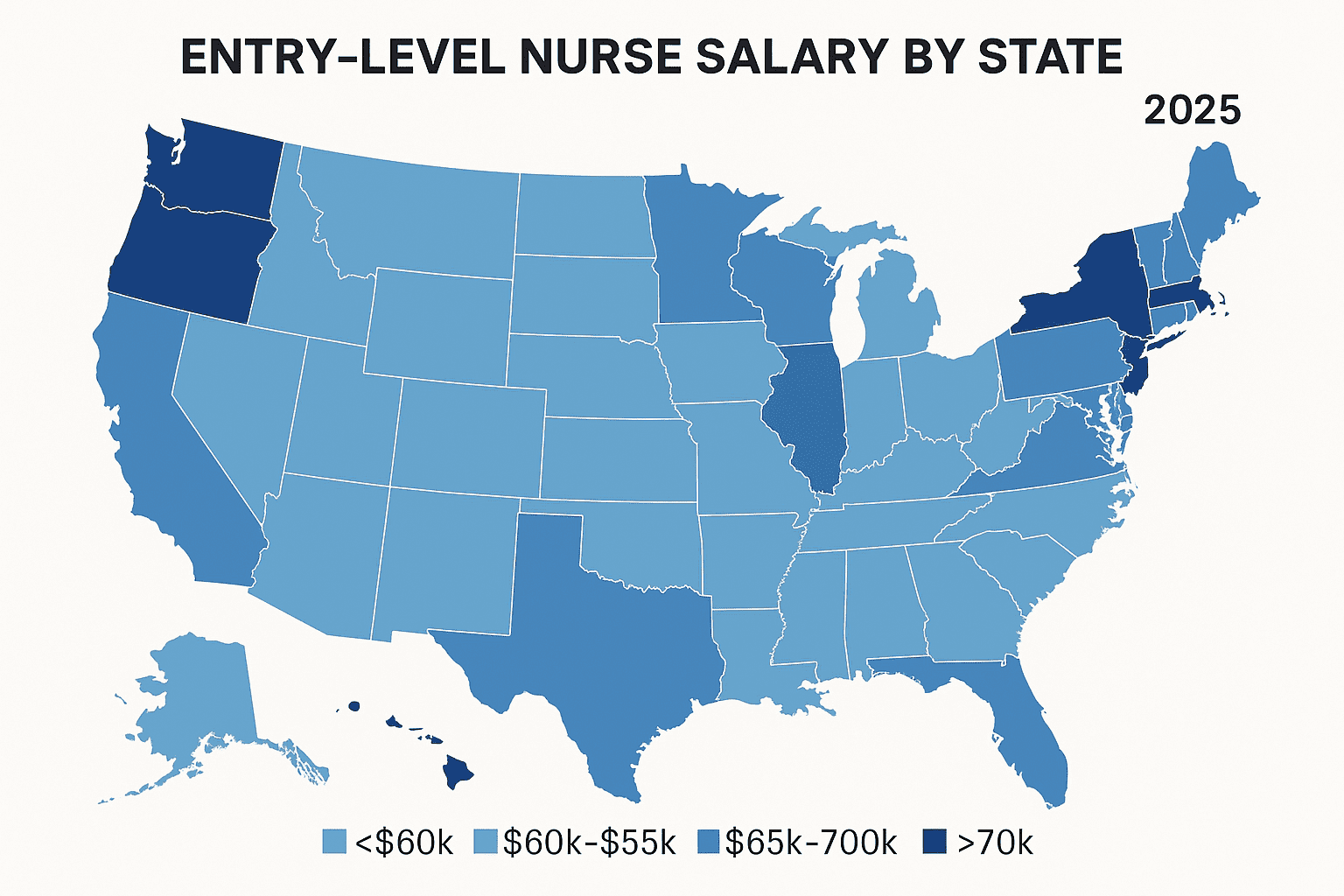
Geographic location is one of the biggest factors influencing entry-level RN salary by state. High cost-of-living areas tend to offer higher pay, while southern and midwestern states may start lower.
High-paying states for entry-level RNs:
- California: $85,000+
- Hawaii: $78,000+
- Massachusetts: $75,000+
Average-paying states:
- Texas: $65,000
- Florida: $63,000
- Ohio: $62,000
Lower-paying states:
- Mississippi: $58,000
- Arkansas: $59,000
Factors That Impact Entry Level Nurse Salary
Several elements determine how much new nurses make:
- Education Level – BSN-prepared nurses earn more than ADN graduates.
- Geographic Location – Salaries are higher in urban and coastal states.
- Healthcare Setting – Hospitals pay more than clinics or nursing homes.
- Shift Differentials – Nights, weekends, and holidays often add 5–15% more.
- Specialty Choice – High-demand fields (ER, ICU, OR) may offer higher starting pay.
👉 Considering whether to pursue an ADN or BSN? Compare outcomes in our ADN vs BSN Guide.
How Entry-Level Nurse Pay Compares to Other Healthcare Careers
Nursing pay is competitive compared to other entry-level healthcare roles. For example, Certified Nursing Assistants (CNAs) average around $35,000–$40,000 per year, while Licensed Practical Nurses (LPNs) earn $45,000–$52,000 annually. By contrast, the average nurse starting salary for RNs is closer to $65,000–$72,000 annually.
Long-term, advancement can lead to even higher earnings. For instance, according to the American Association of Colleges of Nursing (AACN), nurse practitioners typically make over $110,000 per year.
This career ladder highlights why nursing remains one of the most financially rewarding healthcare fields.
How to Increase Your Salary Early in Your Career
If you’re just starting out, here are strategies to maximize new nurse pay:
- Earn a BSN – BSN-prepared nurses average higher salaries and career growth.
- Apply to urban hospitals with high patient demand.
- Take night/weekend shifts for differential pay.
- Specialize early in critical care or surgical nursing.
- Explore travel nursing after gaining 1–2 years of experience.

Job Outlook for Entry-Level Nurses
Nursing remains one of the most stable career choices in healthcare. The BLS projects 6% job growth for RNs through 2032, faster than the national average.
The aging population, chronic disease care, and staffing shortages make the entry level RN salary not only competitive, but also secure.
👉 Check out our Types of Entry-Level Nursing Programs guide if you’re considering long-term earning potential.
Nursing Programs to Start Your Career
Your earning potential as a nurse starts with your education. Different nursing programs prepare you for different levels of pay and career opportunities:
- Certified Nursing Assistant (CNA) Programs
- Short-term training (4–12 weeks)
- Starting salaries around $35,000–$40,000
- Good entry into healthcare, but limited upward mobility
- Practical Nursing (LPN/LVN) Programs
- Typically 12–18 months
- Entry-level salaries $45,000–$52,000
- Great for fast entry into nursing, with the option to bridge to RN
- Associate Degree in Nursing (ADN)
- 2-year program at community colleges
- Prepares you for RN licensure
- Entry-level RN salaries $62,000–$68,000
- Affordable option, but some employers now prefer BSN-prepared nurses
- Bachelor of Science in Nursing (BSN)
- 4-year degree at colleges/universities
- Prepares you for higher starting salaries ($68,000–$75,000)
- Opens doors for leadership roles and graduate study
👉 Learn more in our ADN vs BSN Salary Guide and explore Top Nursing Schools Near You.

FAQs About Entry Level Nurse Salary
1. What is the average entry level nurse salary in the U.S.?
The average entry level nurse salary for RNs is $65,000–$72,000 per year. LPNs typically start between $45,000–$52,000 annually.
2. Do entry-level nurses make good money compared to other careers?
Yes, the average nurse starting salary is significantly higher than CNAs and competitive with other healthcare roles.
3. Which state has the highest entry level nurse salary?
California leads with $85,000+, followed by Hawaii and Massachusetts.
4. Does having a BSN affect entry-level nurse salary?
Yes. BSN graduates often earn $3,000–$7,000 more per year than ADN graduates.
5. How can a new nurse increase their salary quickly?
Take high-demand specialties, work differential shifts, and consider travel nursing after 1–2 years.