
Last reviewed: 12/22/25
Updated for accuracy: 12/22/25
Reviewed by a Registered Nurse Educator
This guide has been reviewed for accuracy and real-world relevance by a registered nurse educator with experience in nursing education and student advising.
The review focused on:
- Accuracy of nursing education pathways (CNA, LPN, ADN, BSN, and bridge programs)
- Interpretation of accreditation and state approval requirements
- Realistic expectations around admissions, clinical placements, and outcomes
- Common challenges nursing students face that affect completion and licensure
This content is reviewed periodically to reflect current nursing education standards and licensure pathways.
If you’ve been searching for nursing programs near me, you’re probably serious about becoming a nurse — but also unsure which school will truly prepare you for the reality of nursing practice. That uncertainty is normal. Nursing education is a major commitment, and the differences between programs aren’t always obvious at first glance.
Some programs look great online but don’t fit real life. Others are close to home but raise questions about quality, cost, or outcomes. This guide is designed to help you slow down, ask the right questions, and choose a nursing program that fits both your goals and your day-to-day life.
Start With Why You Want to Become a Nurse
Before comparing schools, it helps to get clear on your motivation. Over time, one pattern shows up again and again: students who choose programs aligned with their real priorities are far more likely to finish.
Ask yourself:
- Are you changing careers and looking for stability?
- Do you need to work while you’re in school?
- Are you trying to enter healthcare as quickly as possible?
- Do you plan to advance to a BSN or graduate degree later?
There’s no wrong answer — but your answers should guide every decision that follows.
Understand the Nursing Pathways Available in Your Area
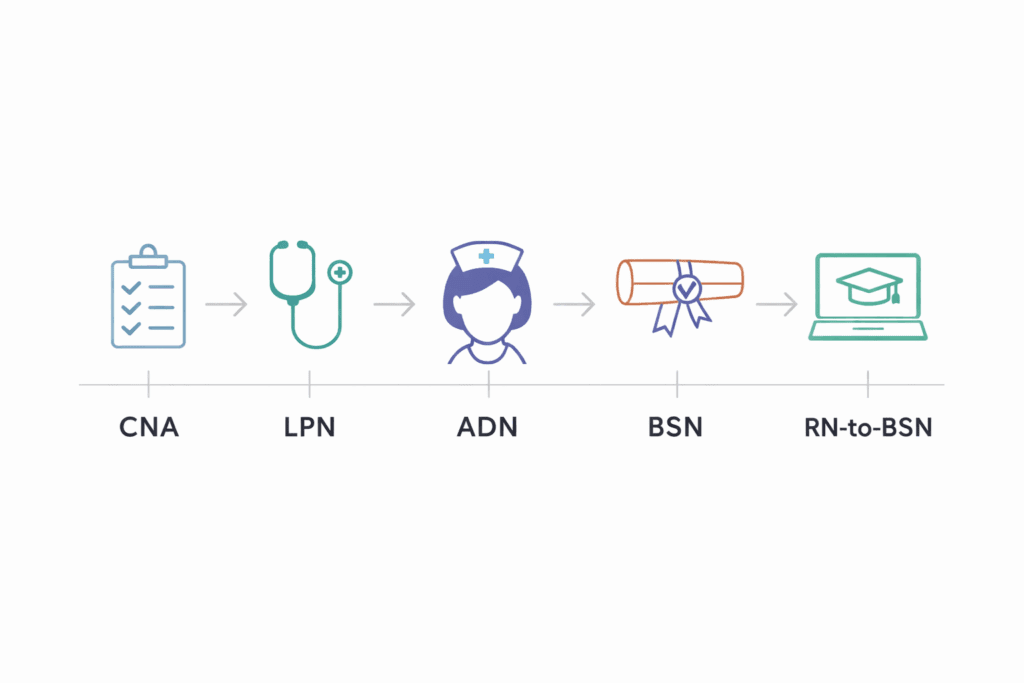
Many students start their search without realizing how different nursing programs can be.
- CNA programs are short and hands-on, often chosen by students who want quick exposure to patient care.
- LPN/LVN programs take longer and involve more responsibility, with the option to bridge to RN later.
- ADN programs are one of the most common and cost-effective routes to becoming a registered nurse.
- BSN programs require more time upfront but can offer broader long-term flexibility.
- Bridge programs allow current nurses to advance without starting over.
No pathway is “better” in isolation. The right one depends on your timeline, finances, and long-term plans.
What “Near Me” Really Means Once School Starts
This is where many students are surprised.
A school may be close to home, but clinical rotations often determine your actual schedule and commute. Some students travel across town — or even to nearby cities — several days a week.

Before applying, ask:
- Where students usually complete clinical rotations
- How far students typically travel
- Whether evening or weekend clinicals are available
- How placements are assigned
Accreditation and State Approval: Don’t Compromise Here

Every nursing program must be approved by the state board of nursing where you plan to become licensed. Beyond that, reputable programs also hold national nursing accreditation through organizations such as ACEN or CCNE.
Accreditation affects:
- Eligibility for the NCLEX
- Credit transfer
- Employer recognition
- Access to graduate education
If a school struggles to explain its approval or accreditation clearly, that’s a reason to pause and ask more questions.
Look at Outcomes, Not Marketing Promises
Strong nursing programs track results — and talk about them openly.
When speaking with schools, ask about:
- NCLEX first-time pass rates
- Graduation and completion rates
- Academic and clinical support for struggling students
- How students are prepared for real clinical environments
Transparency here is often a sign of program quality.
Admissions Competitiveness: What Students Often Underestimate
Local nursing programs can vary widely in how competitive they are, especially at community colleges.
It’s reasonable to ask:
- What GPA successful applicants typically have
- Whether entrance exams are required
- How many applicants apply per seat
- How often new cohorts begin
Applying to multiple programs is common — and often the smartest approach.
Schedule Fit Is Not a “Secondary” Issue
Many students don’t struggle academically — they struggle logistically.
Think carefully about:
- Full-time vs part-time enrollment
- Day, evening, or weekend schedules
- Policies for missed clinicals
- Flexibility during illness or family emergencies
A program that fits your life is far more likely to be one you complete.
Community College vs Private Nursing Schools
Community colleges often offer affordability and strong local hospital ties, but admissions can be competitive and start dates limited.
Private schools may offer more flexibility and quicker starts, but usually at a higher cost.
Neither option is universally better. The right choice depends on your finances, timeline, and competitiveness as an applicant.
How to Narrow Your Options Confidently
At this stage, many students feel overwhelmed by choices. A simple, effective approach:
- Decide on your target credential
- Confirm state approval first
- Set a realistic commute range
- Compare outcomes and clinical quality
- Apply to more than one program
Compare Programs Side by Side
This is where many students find it helpful to use a comparison tool rather than juggling tabs and brochures.

⬇️ Nursing School Finder Tool
Explore nursing programs available in your area and narrow your options more efficiently.
Programs shown are based on location and program type. Inclusion does not imply endorsement.
Questions Worth Asking Before You Apply
When speaking with admissions staff, clarity matters. Consider asking:
- Is the program state-approved and nationally accredited?
- What is the realistic total cost from start to graduation?
- Where do students complete clinical rotations?
- What support exists if a student struggles?
- How transparent are program outcomes?
Programs that answer directly tend to respect their students’ time and investment.
Red Flags to Take Seriously
Be cautious if a program:
- Avoids discussing accreditation clearly
- Cannot provide outcome data
- Promises “fully online” pre-licensure nursing
- Uses pressure tactics to push enrollment
- Is vague about clinical placement details
Trustworthy programs encourage informed decisions — not rushed ones.
Choosing the Right Nursing Program
Choosing a nursing program isn’t just about proximity. It’s about preparation, support, and fit.
Start local, ask thoughtful questions, and don’t rush the decision. A well-chosen program doesn’t just help you graduate — it helps you become the nurse you set out to be. These details often matter more than campus location. You can also explore programs using our nursing school finder to compare options by location, credential, and approval status.
How We Evaluate Nursing Programs
AllNurseSchools provides educational content to help prospective students make informed decisions about nursing education. We do not rank or endorse individual schools.
When evaluating nursing programs, we consider:
- State board approval
- Accreditation status
- Publicly reported outcomes (such as NCLEX pass rates)
- Clinical training structure
- Admissions transparency
- Cost disclosure and clarity
Our goal is to help students understand tradeoffs, ask better questions, and choose programs aligned with their goals and circumstances.
About the Author
This article was written by the AllNurseSchools editorial team, which specializes in nursing education research and student advising content.
Our writers focus exclusively on U.S. nursing pathways and rely on publicly available sources, including state boards of nursing, accreditation standards, and program disclosures. All content is reviewed for accuracy and updated periodically to reflect changes in nursing education and licensure requirements.
Editorial Disclaimer:
Content on AllNurseSchools.com is for informational purposes only and is not a substitute for guidance from nursing schools or state boards of nursing. Program requirements and licensure rules vary by location and may change.